Sunday, February 19, 2006

Beet wine

About time I got around to posting about this... I have made wine. Yes, beet wine!

This is my first time making wine; but now is the time to try my hand at making it. I always wanted to do this. My neighbors and I back in Montana have talked about making chokecherry wine, but never found the time to do so. My good NoDak friend, Rod, learned how to make wine this fall. He got the idea after visiting a winery during the 2005 edition of the CANDISC bicycle ride around N. Dakota. He has made successful batches of apple, plum, and chokecherry wines, among others.

Well, what do I have to make wine from? I hardly had any of my apples left. I didn't pick any chokecherries this year. My garden beets did really well this year and I ended up with more beets than even I cared to eat. Lo and behold I found a few recipes online on how to make beet wine. Well, why not?

You may remember my earlier post about my schleping lots of garden stuff on the train from MT to ND? Beets! Lots of beets. Now you know why I brought them with me!

Rod, and most recipes, said the fermentation process during wine making takes 6 to 8 weeks. Therefore the first thing I did after getting here was to cut up and cook the beets and then start the fermenting process. Rod and I did this in his kitchen before Christmas. Being guys we were a little messy - and beet juice is messy - so the kitchen got a little 'red'. Rod's wife, when she saw the kitchen, bit her tongue. Rod and I applied some elbow grease and cleaned up all of our mess once we were done, and I think (hope) all was forgiven.

The cooked beets were placed in Rod's 6 gallon pail, along with 9 pounds of sugar and enough water to fill the pail to the 5 gallon level. Campden tablets and a few other chemicals were also added. Then I took it all home. The pail of beets had a strong aroma!

24 hours later it was time to start the fermenting process. I started the yeast and then added it to the beet mixture. The next morning, re-reading the notes, I read that one should pour the yeast on top of the beet mixture. Do not stir and mix the yeast into the beets. Oopps. Maybe that is why the yeast mixture seemed lackluster.

Rod gave me another batch of yeast which I carefully poured on top of the beet mixture. This time the yeast took off. Now in addition to the smell of beets (yum?) the fermenting process was starting to give off an alcoholic smell. Hmm.. must be working!

After about a week it was time to remove the cooked beets from the mixture. By now there wasn't much left to be extracted from the beets themselves. Still I squeezed and squeezed and squeeeezed... the mesh bag of beets to get all the beet juice I could. A little more beet flavor can't hurt, can it? By the time I finished the squeezing, my hands were red, red, red! It took a long time and a lot of scrubbing to get back signs of my normal color.

Then Rod and I transferred the mixture from the 6 gallon pail into one of his carboys. Carboys look like one of those jugs of water on top of the old style water coolers. In fact these jugs can be used as carboys. I think that is where Rod got his carboys. (That's also the reason for the duct tape!)

Now to wait. This is where the 6 to 8 weeks comes in. I watched the bubbles rise through the liquid to the top of the bottle. Quickly rising. Many, many bubbles. All streaming upwards along the carboy's slope to its neck, which was sealed by an airlock. The airlock releases air from the bottle and does not not let it get inside. The next day the water in the airlock now had a pinkish/reddish hue.

My beets fermented really fast! After 7 to 10 days the hydrometer check showed the yeast had already converted all the sugar to alcohol. So much for weeks and weeks of fermentation! Now was the time to stop the fermentation process. By now I already had my first cataract surgery and had blurry vision. So I took everything back to Rod's house to have him help me with these steps. I also returned his two boxes of empty wine bottles - now clean and label free.

After adding potassium sorbate to kill the yeast, we let the beet mixture sit 24 hours to fully stabilize. Then Rod re-racked the mixture into another carboy before he added the clearing (fining) agents that encourage any pulp to fall to the bottom of the carboy. I left the mixture at Rod's house for him to do this for me. I was about to have my second cataract operation in a few days.

While I was at Rod's house I helped him bottle one of the two wines he was in the process of making: strawberry/kiwi. Rod had bought a nice corker that easily and quickly put corks into the wine bottles we filled, and the two of us made short work of bottling his wine.

Now to wait again. After about 10 days, on a weekend, we got together again to check my wine. After moving the mixture from one carboy to another we found plenty of sediment left behind. We sampled the beet wine. Strong and with an earthy aftertaste. Well, I did see some sediment move though the siphoning tube along with the liquid. Rod commented that this siphoning took longer than usual for him as the liquid mixture was thicker than his previous wines. Hmmmm... I had time before returning to Montana so we added another round of fining agents and let the mixture sit another week for more settling.

This time the earthy aftertaste wasn't as noticeable. Success! And I was pleased with the wine's color. The color you can see in the photos below.

Rod has experimented during his wine making on sometimes adding sugar water to sweeten the wine a little before bottling it. He had done this with his strawberry/kiwi wine before we bottled it. I am not sure which way my bottled beet wine will go: will it stay the same, sweeten, or become more acidic? Since my wine was near my tolerance for acidity in a wine, and the wine had a good body to tolerate sweetening, I decided we should add some sugar water to sweeten it a little. That way, if the bottled wine does turn more acidic over time, it will still be drinkable.

More sugar water sweetened the wine up some. I didn't have much room to work with now. Any more sugar water and the mixture could quickly become too sweet. And in case the wine sweetened with age, I didn't want it to get too sweet. I'd say "and fruity" but these are beets we are talking about after all, not fruit.

While the earthy aftertaste was now gone (or masked), the wine is after all made from beets. Think and you shall notice. Shhh!! My beet wine has body and still does taste of beets even through all that alcohol. But it's wine.

Enough tinkering. Enough sampling. Time to bottle! Besides Rod was also working on a batch of concord grape wine and peach(?) wine. Between sampling all our experiments with these wines, and the cheese and crackers, it was time to bottle my wine before our stomachs and taste buds gave out, or the effects of the wine made us too careless. Oopps... a little spilled on the carpet. Where is Rod's carpet cleaner machine? Got to clean it before his wife finds out! Beside being very noticeable, beet red is not a good carpet color!

We bottled 29 bottles. Actually closer to 26 bottles as 6 bottles were half sized bottles. Those bottles are for friends who want to try my wine. A little is probably all they could handle. I gave Rod 6 full bottles in exchange for all his help. I offered more but that was all he wanted. Based on its strong flavor, he felt it would take me years to drink all my wine. Possibly...

Then Rod and I got to work on designing a label for my wine. We came up with what I think is a nice label, and one representative for me. Tall Pines Winery presents "bietola rossa". We used babblefish to find a neat sounding name for my wine. "Bietola rossa" is Italian for red beet. Appropriate, eh?

At the local Gourmet Chef store I bought a re-sealer to use on opened wine bottles. I figured with my wine I wouldn't drink the whole bottle at one time! Turns out I was right!

I have had a few bottles of my wine since we bottled them all. I was pleasantly surprised that after a few weeks, and chilled in a refrigerator, the wine tastes better than when it was originally bottled. It's aging well? It also helps to drink the wine with a meal, and not sipping and re-sipping it warm before bottling it. Still, it takes me several meals to drink one bottle. Partly because of the strong flavor, and partly because after a glass and a half I can feel the alcohol's effect on me. And I don't presently have a pretty girlfriend to, ahem, enjoy the wine's effects with when I get silly.

Here's to my wine improving with age! And to me making more wine this year! (Anybody got any empty wine bottles they don't need?)


Flashlight behind the bottle

Against light

In sunlight

Look at the color of the wine.

Thursday, February 16, 2006

Post-cataract checkup

I had my final "post-cataract operation" eye checkup today. My eyes look fine. I am to continue using the Pred Forte drops twice a day for another week, and then that's it.
The next to watch for is if a "secondary cataract" develops. This can happen because the eye's lens wasn't 100% removed. A small amount is left in the eye to act as a small barrier in the eye to reduce the chance of infection. This remaining part can later get cloudy ("secondary cataract"). The doctor then would use a laser in the office in a short procedure to zap the lens and clear it up. A secondary cataract has a greater chance of developing in younger people (like me!) who initially get a cataract.

Otherwise I have 20/30 vision in my dominant eye and 20/60 in the other eye. My vision is good enough I don't need glasses (even to read) except in lower light situations where I want to make what I see sharper. I checked with my insurer, Assurant Health, to see if they will pay for my glasses since my vision changed due to my cataract surgery. I got a "submit a request with the appropriate medical info and we'll see" answer. Now to find someone who sells eyeglasses and who also will submit the insurance paper work.

I also found out the clinic which did my surgery is an "out of network" provider to me. I live in Montana and had the surgery done in N. Dakota. Apparently the clinic would be "in network" if I lived in N. Dakota. To me "in and out of network" would mean whether or not the insurer and clinic have an agreement on medical care and payment (in the network of approved health care providers), not whether you live in the state. "In and out of network" is a big deal as "in network" means the insurer pays 100% after my deductible is met, while "out of network" means they only pay 80% after the deductible is met. Assurant said to talk with my network provider, and my network provider said N. Dakota clinics are not "in network" as they are not in Montana, and if I didn't agree to talk with Assurant. "I just did and they said to talk with you."

Don't ya just love health insurance?!

Wednesday, February 15, 2006

Winter bicycling photo

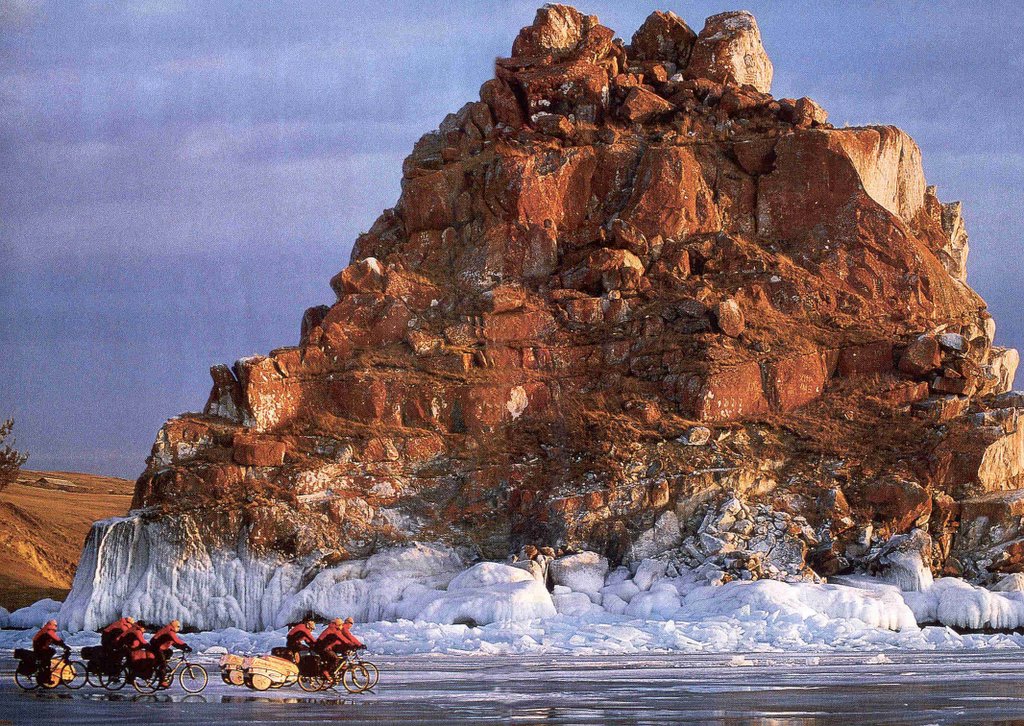
To go along with my earlier post about winter bicycling... a beautiful photo.

Lake Baikal in Russia is a place I would like to visit some day. The oldest and deepest lake in the world. Doesn't it look beautiful? Doesn't the bicycling look like fun? When can we go?

Monday, February 13, 2006

Tree trimming

The weather man predicts that cold weather is coming to ND. The high temperature by Friday is suppose to be barely above zero. Hmmm... time to do some outdoor work today while the temperature is still in the 40s.

Yes, there are trees in N. Dakota. Mom has a row of caragana, green ash, a pine tree and some Chinese elm trees growing along the property line. There are only two Chinese elm trees left as my brother and I have cut down the others over the years. It seems as if one doesn't abuse and really cut and trim Chinese elm trees they will die. Today my brother and I trimmed the last 2 trees down to the height of the neighbor's garage as they had been left alone the past few years and now were dying.

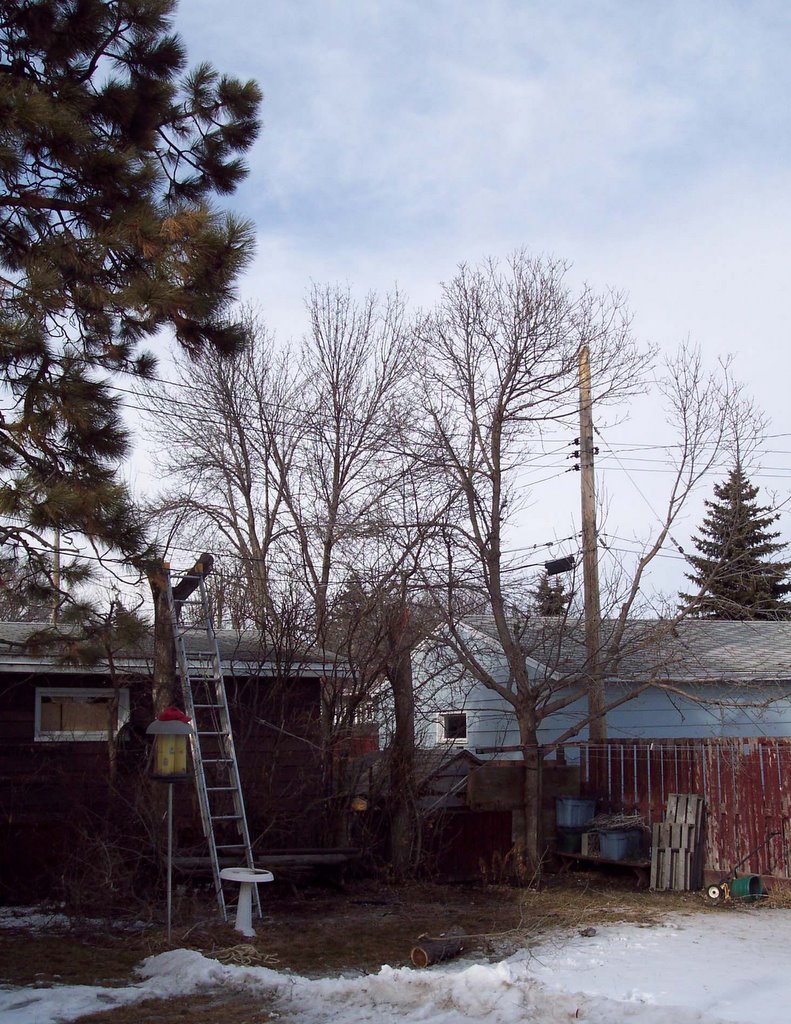
The tricky part was that several power lines and the cable TV line (which I accidently cut some years ago while tree trimming ) run to the house from the power pole in the yard's corner. From the following photo one can see the left Chinese elm tree especially leans over the lines, which is the reason these trees were the last 2 to be trimmed!

I had to trim the trees a few pieces at a time. First I extended the metal ladder to its full height (note, the ladder in the photo is barely extended), and standing near the top of the ladder, I used a pole saw to trim as high as I could reach. As the ground was snowy and slippery my brother held the ladder so it would not slip out from under me.

You know, even the tree branch that didn't lean right over the lines still fell on the lines. Argh! But it was a smallish tree branch and light from having been dead all year, and therefore bounced off the wire. Whew!

The second tree was more of a problem as it definitely leaned over the wires. To make matters worse the wind picked up, and no, the wind did not blow the branches away from the wires. I had to reach as high as I could and trim several of the branches to be as small as possible. Again the falling branches brushed the wires but to little effect.

Now for the bigger trunk. I used my brother's chain saw on a pole and went for it. The piece I cut turned out to be bigger and heavier than I thought and did not fall in the direction it was suppose to fall. When it hit the lines (naturally! *sigh*) it really shook them up and then came to a rest one end on the lines and the other end on the trees around me. Augh!

I used a large broom to push the branch off the trees and lines. The lines did not break, but I had my brother go in the house to see if we still had power. Yes.

Now to cut the tree trunk lower. Imagine my surprise and horror when the next section of the tree trunk fell towards the wire and brushed against it before falling to the ground. How did it reach the wires?!!! Again the wires jumped up, down and all around but did not break or lose power. Whew!

Somehow I was able to finish the tree trimming with no further excitement.

Sunday, February 12, 2006

Winter bicycle riding

Thanks to the internet, I am not alone. I found a web page with info and stories on Ice Bicycling. That's right - I am not the only one who rides his bicycle during the winter in places where it is cold and there is snow. Who would have thought?

Back when I worked in Minnesota I was the only person at work who bicycled to work all year. Even in the snow and cold. Until he retired the only other person to also ride all winter was Ted, one of my managers. Having the only other winter bicyclist be in the same department as me was a rare co-incidence as the company at that time employed near 8,000 people. I only had about 2 miles to ride to work so it wasn't a big deal. If I drove my car it, and I, wouldn't be warm by the time I reached work. So actually I was warmer riding my bicycle. I got lots of comments though.

One day after my coldest ride ever (officially -35 F; unofficially -39 F), a co-worker informed a local TV news station. A young female reporter called and the station wanted to do a story on me for the local news. They wanted to interview me ("Why do you do this?!"), film me in the morning getting ready, and then film me as I rode down the street. I declined. I got enough of the "you're crazy!' comments at work.

Actually riding to work in the summer was more of a problem. With Minnesota's heat and humidity I would either need a shower after my ride, else I would have to ride slowly. In the winter the biggest thing would be to get the ice out of the beard I grew to protect my face during winter riding.

The winter roads weren't a problem as Minnesota heavily salts their roads. During a snowstorm the roads and their shoulders would be wet with water. With no fender over my rear wheel I would get a large biker's stripe on my back from the tire spray. I would improvise a fender by placing old newspapers in my bicycle's rack. It is surreal to see running water on the street from the melting snow when the temperature is only 10 F above. In the spring before the city cleaned the streets the fine white salt dust would blow around and be a hazard to a bicyclist's lungs.

A few times freezing rain coated the roads during the work day. I would leave a little before rush hour, else after it was over. On one particular icy day I found confidence was the key to staying up right on my bicycle. After riding much of the distance over pure ice, a block from home I had a doubt and a moments hesitation and down I went.

I find now, being a little older (and maybe wiser?), I don't ride as much in the winter. Partly it is because I don't have to commute to work, but also because Montana doesn't salt the roads and therefore most winter roads are often covered with a layer of slippery compacted snow. I find bumpy, uneven, compacted snow is more of a problem than riding on ice.

The stories on the "Ice Bike" web site could be interesting. But I find these days I don't have the same interest in testing myself against nature. Therefore the 350 or 1100 mile ride in Alaska doesn't fire my imagination like it may have once done. Earlier this week a cold front came through with snow and colder weather. I haven't ridden my bicycle in days.

Am I getting smarter, or just getting older?

Map Population

Here is an interesting map. A view of the U.S.'s states based on their population size rather than their land mass.

The eastern U.S., rather than looking small, now is the great majority of the map.

The map has the U.S. looking like it is on steroids as the country looks so distorted and misshapen. It just looks and feels so wrong, doesn't it?

And where I live? Yes, where is Montana? It is so deflated for being the 4th largest state in terms of land mass.

Well... I prefer living in the uncrowded part of the U.S. With such a large difference between the land size and population size... the eastern U.S. must be awfully crowded.

Friday, February 10, 2006

In Nodak; missing MT

Yes, I still am in North Dakota...
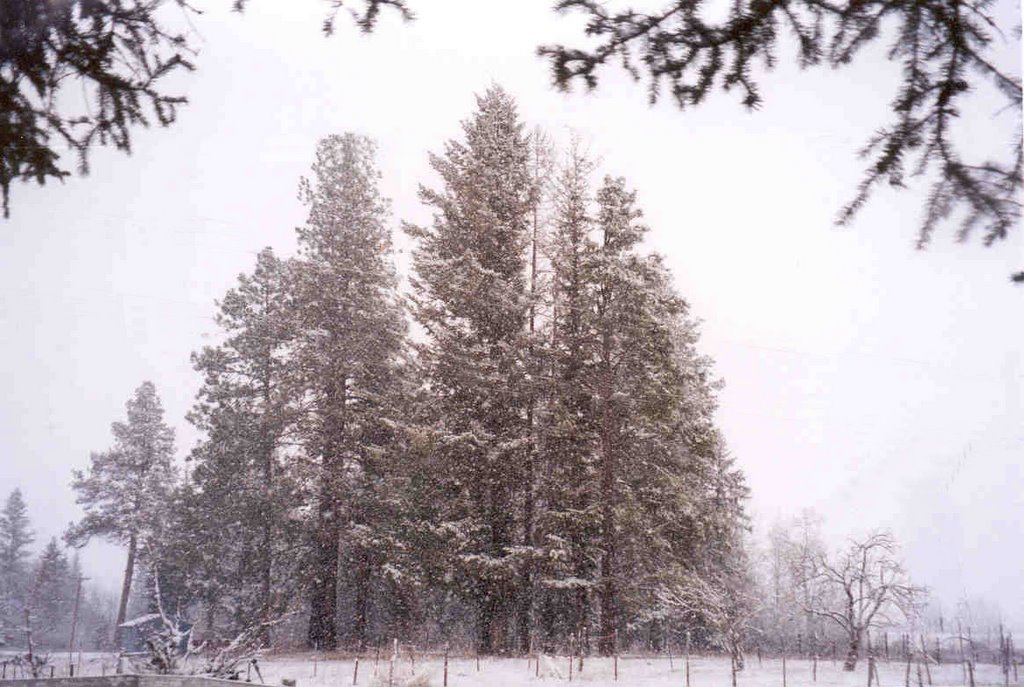
But I am missing my home's tall pines...

Thursday, February 09, 2006

Laurie Anderson

I was looking around for a video to add my my blog. I ran across a few videos by Laurie Anderson. For those who don't know of Ms. Anderson, she was an avant-garde musical artist back in the 1980s. Apparently she is still active today. She has a short video for the PBS documntary series "Art:21 - Art in the 21st Century" where she explains her approach to art.

Her album, Big Science, is where I discovered her. This is what Wikipedia says.

Pretty much all my friends have said... "Ummm... you like this?! Do you think this music?" No matter, with my eclectic taste in music, I do like her music.

A friend had lent me the Big Science album and I loved it. Back then in my small town no record stores carried this album. (During the pre-internet days it was hard to buy anything not carried in town.) This friend had gotten the album on one of his trips to Minneapolis. I had another friend record it onto cassette tape so I could have a copy and continue to listen to the music. This friend did not like her music and declared his record player would never be the same.

I love all the songs on this album, and played it and played it. I think I knew all the lyrics back then. But I haven't listened to the album in over a decade. I need to find it and listen again. It's great to find a few of her videos online.

In my blog's sidebar I have a link to the "O Superman" video from this album. This link is to the Wikipedia listing about the song. Laurie only made 4 formal videos and "O Superman" is the only one from this album.

At the time I was majoring in computer science. I remember that for a project that involved word manipulation I used the lyrics from several of the album's songs. I got an "A" on the project and feedback that the person grading my program loved my choice of words.

Here are the lyrics in case you didn't follow earlier link to the album. Keep in mind when reading them the electronic music and her phrasing and pauses greatly add to the song's effect. You either like it or you don't - there is no in-between.

I also have her album, "Mister Heartbreak", which is another good album. William S. Burroughs participated on one of the album's songs.


The following video is from her concert film (and album), "Home of the Brave". You know, and I should remember for sure, but I think I may have seen this movie in Minneapolis back in 1986. At the Uptown Theater. 20 years ago - no wonder my memory is fuzzy!
The "Language is a Virus" song title is a quote from William S. Burroughs.
  • Paradise
    Is exactly like
    Where you are right now
    Only much much
    Better.

Monday, February 06, 2006

Shift tricycle

"The Shift bicycle features a swinging rear hub, which allows the rear wheels to pitch in and out. The hub allows for the rear wheels to provide a larger or smaller stance depending on the amount to weight on the rear wheels. An internal belt keeps the drive train away from the children for safety.” - designapkin.com


What a cool tricycle/bicycle!! As my friends know I love bicycling and bicycles.

I wish I had this tricycle to learn on back when I was a kid. I asked my mom if she had a photo of me and my training wheel bicycle that I could share on my blog. She said she didn't have one because I learned without training wheels. I thought back and it was my brother's bicycle with those temporary little wheels that attached to the rear of the bicycle on each side. The metal supports would invariably bend on one side and cause the bicycle to lean when starting out. I now remember I had someone push me up to speed then let me go on my own. I guess time heals all wounds as I don't remember any crashes from my learning phase - although I am sure I had a number. And those crashes didn't prevent me from taking up bicycling with a vengence when I got older.

Here is an article about the inventors and more information on the tricycle.

Kissing to the Right

A study conducted by Onur Güntürkün of Ruhr University in Bochum, Germany, found that found that about 65 percent of people tilt their heads to the right when kissing.

"Among the 124 kissing pairs, 80, or 64.5 percent, veered to the right while only 44 (or 35.5 percent) veered to the left. Most of the subjects showed no hesitation at all when it came to positioning their head."

Several articles talk about this. One is more about his study, another also talks about a brief history of kissing in addition to his study, another also has quotes from another researcher speculating whether kissing to the left is less emotional.

I am left handed so I wondered if being right or left handed had an impact on the way one tilts their head.

"The study says kissing side preference is not related to handedness. The ratio of right-handers to left-handers worldwide is about eight to one, but that's likely tied to culture and reality more than anything else, says Gunturkun. Because so many tools and products are created for right-handers, many lefties become ambidextrous just to cope. "

Well that fits me. Ambidextrous sometimes, depending how I learned to do something.

"while newborn humans show a right head-turning preference, that preference seems to disappear by the time the baby is 3 to 6 months old. It's not until years later that the preference for the right hand, foot, ear, and eye is established. "

But this doesn't mean the hand, foot, ear, and eye must all be dominant as right or left. I am left handed. My cataract pre-surgery testing showed my right eye is dominant. I think I favor kicking with my right foot. No idea on which ear is dominant but I cock my head to hear better using my left ear. While I catch with my left hand, I bat right-handed. I guess I am all mixed up.

I think I learned to kiss from a girl who kissed to the right.

So how do you kiss?

Sunday, February 05, 2006

Team Penning

Today as I was out on a bicycle ride I rode past the N. Dakota State fairgrounds. I noticed a few horse/stock trailers behind the All Seasons area so I rode over. Outside the livestock arena I saw a couple guys with lassos and a horse. I asked what was going on. A team penning competition.

I parked my bicycle outside the building and went inside to have a look. While lots of lights lit the inside I noticed the same thing now since my cataract operations: inside large buildings things look blurry. Not sure why; whether it has something to do with less light. I'll have to ask my eye doctor tomorrow.

A large rectangle made up of temporary metal corral panels covered much of the floor. This was the ring for the penning competition. I went over to the north side and looked through. It was near where the cattle were returned after being roped. A person stationed at this NE cattle exit would undo one or both of the lassos if they were still on the steer/heifer and let it back into the passage way. This passage led the entire east length of the corral back to the SE corner where the steer/heifers would again be released for another team's ride. Not sure how many head they had, but it was enough to keep the competition flowing smoothly with no waits for cattle.

The person whose lasso still was attached to the cattle would ride their horse along with the cattle to this passage until their rope was unhooked. Man, these horses were big. I moved to the west side partly to get away from the horses and also to get a better view.

The riders were half-and-half between cowboy hats and baseball caps. Only one rider lost his hat during the ride. The few women riders tended not to wear hats.

It didn't feel cold in the arena but sometimes I could see 2 white streams of air come from the horses' nostrils. One time when the judge was waiting for the next team to get ready, his horse took a "bathroom break". Steam rose from the floor under the horse where he had urinated.

The steer/heifer would enter the ring from the SE corner and 2 people on horseback (the team) would follow on each side. The rider on the cattle's left would lasso its head, then move to the left across the ring before they ran into the north fence. The rider on the right would lasso the cattle's hind legs as the first rider and horse pulled the cattle along. The cattle need to keep moving their legs so the legs can be lassoed. Many times the second roper took longer and the lead horse reached the west corral and had to turn south to keep moving.

The cattle had horns strapped to their head. Anywhere the lasso would hold on its head was acceptable; whether around the head and neck (preferable so the lasso wouldn't slip off), horns, nose, wherever. Ideally both legs would be lassoed. Once the cattle was stopped time was taken. If only one leg was lassoed the team received a 5 second penalty. If neither leg was lassoed: no time.

The heat is 4 attempts with an average of the 4 times. When a team did not get a steer/heifer lassoed it meant "no time" and the team was eliminated. No more chances. At the end the 6 teams with the lowest times competed one more time to determine the winners.

This team penning competition was arranged and run by an outfit from Billings, MT in conjunction with Wrangler western wear who were trying to expand it in North Dakota. In Montana team penning is rapidly gaining popularity. A few years ago the cattle pastured at my place where taken out a few times on loan for a local penning competition. No wonder the cattle came back kind of tired, but kind of ornery!

This competition was held yesterday and today. The penners are ranked in ability and the better teams competed yesterday, and the beginners and novices were competing now. 89 teams started today although there were only around 2 dozen teams remaining when I stopped by. This event was not advertised or promoted as I heard nothing about it. The entry fee for each team is $60 - which can go quickly if the team can't rope their cattle on the first try and are eliminated.

I know all this because I talked with a Native man standing nearby and also watching. He looked to be in his late 50s. He said he had earlier competed riding his "paint" but now was out of the competition. His son was still in it. This guy said penning was something recent the last decade or so. Before that he would rodeo. He said he once was in the final 6 in a competition for a $11,000 first place prize but ended up third. Sometimes the prizes include saddles and he had won 6 or them. So some money can be made, though most don't make money. Especially considering the cost of the horses, saddles, horse trailers, gas. They do it for the challenge and sport of it.

The event wasn't set up for spectators. To watch one stood in the dirt sawdust muck also used inside the corral, leaned against the corral and looked through it. Horses were tied to the outside of the corral and once one horse had an itch on his head. I stopped leaning against the corral as I was afraid between the horse scratching and me leaning our panel would fall over.

Teams with the top 6 times, and done with their runs, remained in the SW corner of the corral. The rest exited out the NW and then rode their horses along the western side of the corral, along where I and others stood to watch. A number of horses were tied to the corral and lassos where hung. Occasionally a rider would come and exchange lassos and I would hand them the one they wanted and tied to the corral the one they didn't.

While mainly a male sport, nothing says it has to be one. While 90 to 95 percent male there were a few women riders. I like watching a woman who knows how to ride a horse. Man, that's sexy! A nice looking woman sat on her horse waiting a short distance from where I stood. I thought of asking her what this was all about (I hadn't talked to the Native fellow yet), but she was watching the other teams. Later I saw she was in the queue for her next try. She was the person who lassoed the cattle's head. Her team did well as she was in the final six. I think she finished 3rd or 4th. Her partner had her same last name - not sure if he was her brother or husband. Husband mostly likely.

A few teams had problems. There was the lasso loop that went around one hind leg of the steer and one front leg of the horse. The horse didn't like that and the loop wasn't closed and they got a 'no time'. Or the lasso that went around a front leg of a steer. Not good either. A few lassoed the cattle's legs but then the rider lost grip of the lasso. 'No time.' Some lead riders had trouble keeping the cattle moving as they didn't maneuver and turn their horse smoothly when reaching the western corral. Or they simply ran out of space as they approached the "top 6" teams waiting in the SW corner. A few cattle made it to the NE exit before being lassoed. The cattle knew this was their exit and ran fast. They had the routine down by now.

Speakers on portable stands were placed around the building. The announcer would call out the team member's name and call the play-by-play, then the final time. While waiting a minute for the next team to get into position the announcer would call out the 2 or 3 teams next in the queue. Old time country-western music also played over the speakers. I didn't recognize the songs. Part way through the event a woman announcer took over for a short while. When she announced the music changed to more of a rock type. Lynyrd Skynyrd for example. Later when the male announcer came back the music was again country-western. During the "final 6" competition the music was suddenly switched to be "Born to be Wild" by Steppenwolf. Huh?

"Get your motor runnin'
Head out on the highway
Lookin' for adventure
And whatever comes our way

Yeah Darlin' go make it happen

Take the world in a love embrace

Fire all of your guns at once

And explode into space
"

All of the 6 final teams won money. Not much money as the winning team got $435 for each of the two team members. If this team had used a certain brand of lasso they would earn an extra $1000 bonus each. They weren't and didn't get the bonus. After they won they got a victory lap around the ring led by a young woman on horseback holding some kind of flag. It was a quick lap as people and teams and horses rapidly began to exit. It was after 4 pm on Superbowl Sunday and many people had to load their horses and drive a ways to get home.

I wasn't expecting this today as I planned on a quick bicycle ride. So I didn't have my camera along. I could have gotten a few good photos. After leaving the arena I had to scrape the dirt sawdust muck off my shoes before getting on my bicycle again.

Saturday, February 04, 2006

Northern Livestock Auction

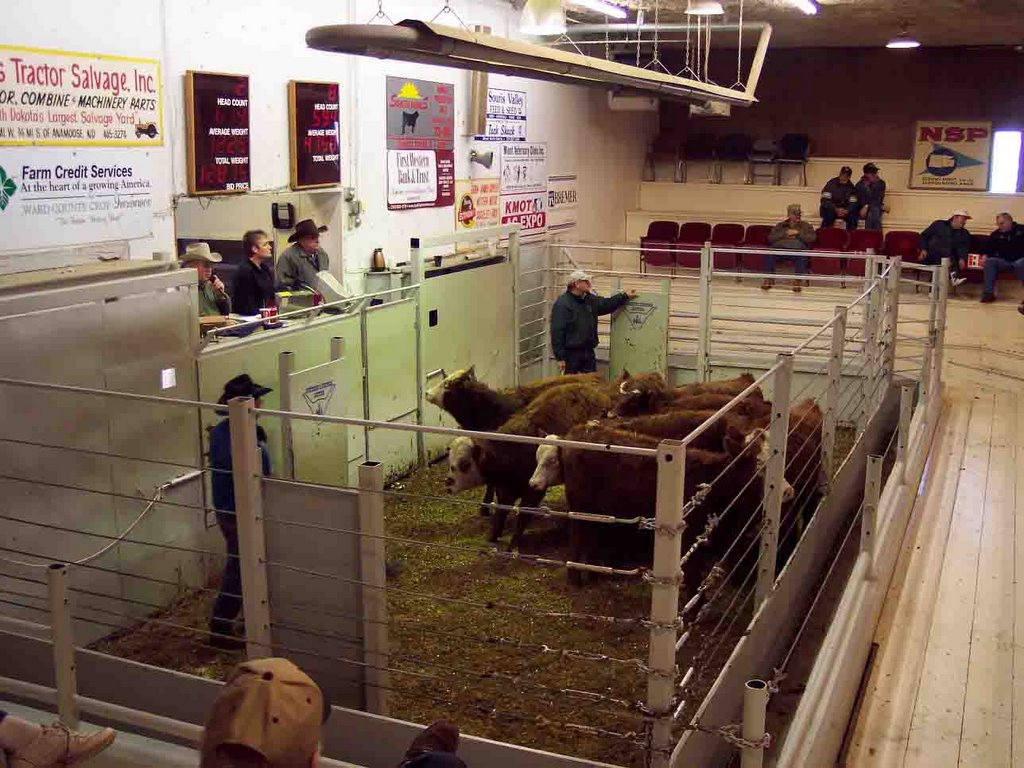
Friday I attended the weekly cattle auction in Minot. I don't know how many head were sold, or when the auction started. I left a little before 2 pm and the auction was still going strong.

As I arrived around 11 am several stock trailers pulled up to unload. Late arrivals like me.The parking lot was half full. The stock trailers were long - 5th wheel types. More cars and trailers were in the parking lot when I left, along with a few semi cattle transport trailers waiting to load.

The auction barn is next to the main rail line, but I don't think many cattle are transported via rail anymore. Times change.

A few days ago I re-watched the 1948 classic western: Red River. John Wayne and Montgomery Clift, as father and adopted son, drive a herd of cattle from Texas to a railroad in Kansas to get the cattle to market. Not sure how accurate the movie is depicting the first cattle drive on the Chisholm Trail. Still, a very good movie.

The movie poster is misleading. The romance is between Joanne Dru and Montgomery Clift - not John Wayne. Her character is tough as nails. This being 1948 it pre-dates the modern feminist stereotype.

Today it was not near as crowded inside the auction barn, unlike the other times I attended. Then all the seats with backs were taken, and many of the seat benches were full also. I imagine the bred cow sale on Monday was the sale people attended this week. The people were almost all male aged 40s on up. A few old timers seemed to be there as a social get together to shoot the breeze. A couple wives were at the auction with their husbands for a short time; and a few old guys had their grandkids along.

The beginning of February - winter - and this auction still sold more cattle than the Missoula livestock auction did during their September sales. Ranching is going away west of the Divide in MT.

The few 200 to 300 lb steers were going for $1.60 to 1.66 a lb. The higher weight (400, 500, 600, ...) cattle naturally were sold for less per pound. I'm learning, so I am still confused why some cattle sold for less than others. I get that heifers are worth less than steers; all black cattle sell for more than colored cattle; certain breeds (Angus) are preferred over others (Holstein); rat tailed cattle sell for less; and long bodies are preferred. But I couldn't see the difference between other cattle - why some sold more and others sold less. I don't have the eye others (especially the professional buyers) have to pick out cattle that will gain weight faster. There can be two dozen head crowded and milling in the ring and a buyer will ask for one to be cut and sold separately (always for less). Because a professional buyer asks, the auction ring complies. Even when it would take a few minutes to cut 1 steer out of 27.

An example of differences: same owner, almost the same weight, same sex, cattle looked the same breed. Different color. 3 head black steers, averaging 605 lbs, sold for $1.32 lb. Next in the ring was a grey 615 lb steer. Body and breed looked the same except for color. Sold for $1.23 lb.

One man and woman consigned a large number of nice looking Angus. Selling points are when the cattle have been vacinated and weaned. His cattle weren't vacinated. And when the auctioner - thinking they had been - asked if they had been weaned the owner mumbled. The auctioner asked again as he couldn't hear. Finally the owner said the cattle weren't weaned. That should lessen the price as weaning is stressful (on the calves and on the people who have to hear the calves bawl). This results in a temporary weight loss. ...mainly on the calves. The price quoted in the above paragraph were for some of his cattle.

I brought my brother's camera along to take a few photos. It was well lit inside so I didn't need to use a flash. But I couldn't figure out how to suppress the flash. I took a couple photos of the cattle with the flash and then noticed the bookkeeper would look at me. I was sitting on the side and wanted a photo of the buyers and didn't want my camera's flash distracting them when bidding. I spent some time to figure out how to suppress the flash (not intuitive - not that it really helps me sometimes). I then was able to take a number of photos without fear of distracting people or getting tossed out.

The temperature was in the teens outside and most of the cattle's breath could be seen snorting out both nostrils when they initially entered the ring. After filling their lungs full of warm air inside the ring I no longer could see their breath. I tried but wasn't able to capture in a photo the sight of their breath.

Friday, February 03, 2006

Breeding & Brain Size in Males

A study found that in more monogamous species, the average male brain size was about 2.6 percent of body weight, while in promiscuous species, the average size dipped to 1.9 percent.

"where the females are promiscuous, the males boasting the largest testicles also had the smallest brains. Conversely, where the females were faithful, the males had smaller testes and larger brains."

The study was mainly with bats, but the article referenced other mammals being similar.

Hmmm..... us guys can't do two things at the same time.

Is this why lately my brain seems to be shrinking... I am not in a monogamous relationship by having a wife or girlfriend?

Roosevelt city park photos

Here are a few photos to go with my earlier post about the Roosevelt city park.

A statue of how Teddy Roosevelt looked when he lived in western North Dakota, or else how he looked during his Roughrider days a decade later. (Looks like the statue needs a little cleaning!)


The sundail. The shadow shows it was a few minutes before 2 pm when I took the photo.


The Burlington Northern (BN) caboose that needs paint.


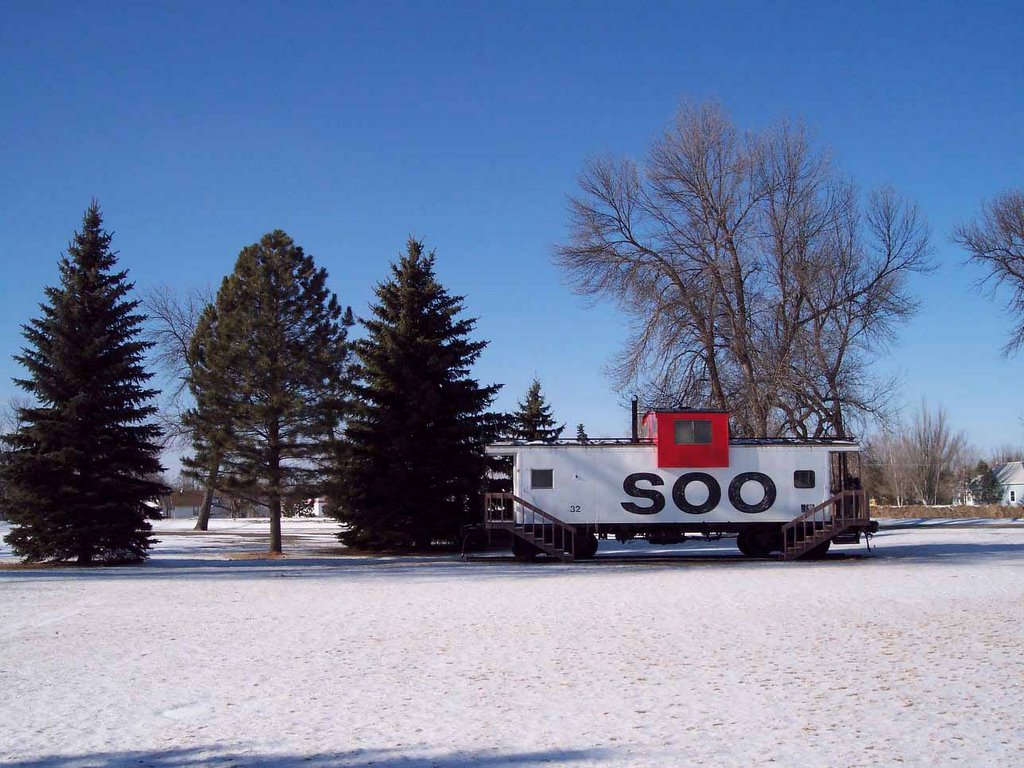
The Soo Line caboose.

The swimming pool and water slide during the off season. I'd say this is where my father tried to teach me how to swim, but the pool has been rebuilt since then. Same location, newer better pool.

Downtown Minot 2006. Main Street is 4 blocks long. 5 blocks if you count where I am standing when taking the photo.
Now looking at all these photos, what do you notice? Yes... blue skies!! People often comment when I tell them I visit North Dakota during winter --- "Isn't it cold?" Usually, but I see blue skies here. Where I live in Montana the sun hardly shines during the winter. This past January they had 2.29 inches of moisture - which is a lot for them! 9th wettest January ever? I wonder if the sun shone there at all?!

Thursday, February 02, 2006

Sex selection

Also... in looking around the internet I ran across some articles on sex-selection.

Recent data has shown an increase in the ratio of the number of male births versus female births in China and India.
"The Academy of Social Sciences in Bejing research times have found that in some parts of China there are 120 boys to only 100 girls because of Sex Selection - natural births produce a ratio of 105 to 100."
Japan on the other hand has shown the reverse.
"A report in October 2000 found that 75% of newly wed couples in Japan want their first child to be a girl."
And in the U.S.,
"This MicroSort service was first offered to clients at the Genetics and IVF Institute in Fairfax, Virginia; 10 of the first 11 babies born using it were girls."
However another study claims that U.S. moms are split 50/50 on whether they would like a boy or girl.

Still, another study has found that when times are tough, women tend naturally to abort a higher percentage of male fetuses. Hmm...

Raising boys today


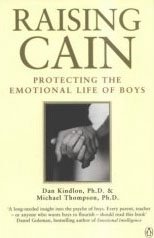
I recently watched the PBS documentary, Raising Cain.This is a very interesting show on raising boys in the U.S. today, and how boys are failing.

The Washington Post has an article on the show and a transcript of an online chat with Michael Thompson.

There is a concern about how the school system in the U.S. is based on a female way of educating, and this is failing boys as they have a different style of learning.

It appears these days that schools (having become female centric since I was in school in the 60s and 70s) and parents (many of them single parents tired after a days work) can't handle the energy of boys, and therefore label it as a "problem". This being America we turn to a miracle drug to solve the "problem". A number of parents I know actually are relieved when their child is diagnosed with ADHD. I wonder how many of these kids really have ADHD?

"Girl behavior becomes the gold standard," says "Raising Cain" coauthor Thompson. "Boys are treated like defective girls." Many boys are being labeled as "bad", or in need of a "time out", or perceived as having ADHD. Boys then feel bad about themselves.

This site has an excellent article that sums up the situation: Boys flunk life 101

While the PBS show and Newsweek cover story are recent, the "Girls rule, boys drool" situation has been perculating for a few years as evidenced in this April 2004 article, "Where the Boys Aren't"

The Jan 30, 2006 issue of Newsweek has an interesting article titled, "The Trouble With Boys".

Newsweek titled their story "The Trouble with Boys." Who choose the article's title, its female author Peg Tyre? At least Newsweek didn't put the story's title on its cover. Wouldn't "Boys in Trouble" be a good title?

The Newsweek site also has a link to some video clips from the PBS documentary.

According to the Newsweek article,
"By almost every benchmark, boys across the nation and in every demographic group are falling behind. In elementary school, boys are two times more likely than girls to be diagnosed with learning disabilities and twice as likely to be placed in special-education classes. High-school boys are losing ground to girls on standardized writing tests. The number of boys who said they didn't like school rose 71 percent between 1980 and 2001, according to a University of Michigan study. Nowhere is the shift more evident than on college campuses. Thirty years ago men represented 58 percent of the undergraduate student body. Now they're a minority at 44 percent. This widening achievement gap, says Margaret Spellings, U.S. secretary of Education, 'has profound implications for the economy, society, families and democracy.'"
Also in the article,
"One of the most reliable predictors of whether a boy will succeed or fail in high school rests on a single question: does he have a man in his life to look up to? Too often, the answer is no. High rates of divorce and single motherhood have created a generation of fatherless boys. In every kind of neighborhood, rich or poor, an increasing number of boys‚ - now a startling 40 percent ‚- are being raised without their biological dads."
The PBS documentary said that only 9% of teachers today are male. And how many of the 9% are phy ed teachers? From my school experience I didn't look up to my phy ed teachers. The schools today are not providing young boys with responsible role models to look up to. From my grade school experience the only teacher I remember is the 1 male teacher I had. From my high school experiences I remember an equal amount of male and female teachers. My male teachers seemed to know when to allow boys to let off steam, and when to rein us in to focus on the task at hand.

Last year a former girlfriend and her son told me how he liked having a male teacher - his first one ever. Now I get it. He was looking for a role model.

Watching the PBS show I was struck as how boys' stories where labeled as bad. One young boy, about 4 or 5, had a story where a bad man killed a horse, then a good man killed the bad man. The female teacher and girl students were upset with the story and the teacher led the class in coming up with a new rule that no one dies in future stories. Instead they would "fall asleep". I noticed the boys in the class sat silently when the teacher asked if everyone agreed.

Then the documentary showed how the young boy struggled to write another story where the bad guy was punished. He hesitated and figited for a while before finally saying that the bad guy would fall asleep. One could easily tell this boy was troubled at being censored. Since this was being filmed the teacher commented on how the boy struggled with his story this time. The teacher then opened up the "no one gets killed" rule, and after a discussion the class agreed that bad guys can get killed. But only bad guys. The boys in the class participated in the discussion and now seemed happier, and no longer felt bad about their contributions and themselves. This ties in with a recent brain study of men and women's brains where men find retribution more rewarding.

While flipping through TV channels the other day I came across Susan Sarandon on the Martha Stewart show. I am not a fan of Martha, but I do like Sarandon, having remembered her from her roles in the movies "The Rocky Horror Picture Show" and "Atlantic City". She talked about how her daughter had no problems studying for the SAT tests, but this year her son is struggling. And Sarandon being a proper Liberal most likely raised her children fairly, equally, and politically correct.

A Montessori Mom wrote about the PBS show on her blog, and on raising her son.

This invisible man blog has some interesting comments and links to other sites.

What triggered my post on this subject? While the "Raising Cain" documentary has been rattling around in my head for the past week or so, the statistics here on one of my favorite sites (as I like statistics).

In reading through articles, blogs, and their comments I find a number of women are surprised at the differences between their sons and daughters; how their sons have all this excess energy. For years feminists have said that boys and girls are really the same, that their differences are a result of society and the child's upbringing. However with MRI scans and further studies, it has been shown that biology plays a large role in the differences. This is part of the reason that politically correct toy purchases often mean those toys are ignored by the children.

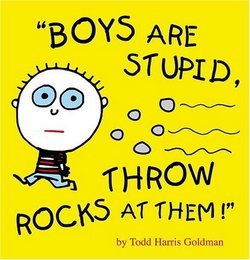
Another article on Wikipedia about boys is about the "Boys are stupid, throw rocks at them!" tshirts and books.

Now all of this will have an impact in the future. If boys and men continue to drop out of school their education and income will suffer.

A 1999 Toronto Sun newspaper survey asked women what they were looking for in a spouse,
  • Would you pick a man who had less formal education than you (1%), about the same (61%), or more (36%)?

  • Would you pick a man who earned less than you (1%), about the same (43%), or more (49%)?

I guess I should give up on finding a wife. I have the education (even if I am not using it presently), but with my recent career change into ranching, I don't have the income. I think I now fall into the "1%" catagory in the above survey. I don't mind if she earns more than me, but apparently she will mind. (-:

I've seen other surveys where women have had similar preferences with education and income. And not just in the U.S., I remember reading a study on how after the fall of communism there were many more educated Russian women than men. The women were very unhappy with the uneducated and drunken men in their country. And no, I wasn't reading about how to "meet hot Russian women now"!

If women think it is hard now to find a husband that meets their standards, it appears it will get worse if boys keep falling behind.

I don't have kids, but based on how society views boys and men, if I ever have kids I probably would wish for a girl. No sense bringing a boy into a society that dislikes and over medicates boys. On the other hand, if I could ever get a son educated and into a good job, he should have a large number of women to choose from for a wife.

I wonder how many other people in the U.S. believe the same as I do? Statistics anyone?

Wednesday, February 01, 2006

Memories of arcade videogames

I remember the 1970s and early 1980s when the arcade games transformed from pinball machines to arcade videogames. This was before the IBM PC was started.

I ran across a site listing old videogames. I was never much of a videogame player, but there were a few games that interested me and my friends.

My favorite game was the original 4-player Gauntlet. It first appeared in 1985.

For months on end in 1985 my IBM co-workers (Tim, Erik, and Scott) and I played this game after a quick lunch at Little Ceasar's Pizza in the mall. I think we all gained a bit of weight during this time.

As I remember: Tim played the Warrior; Erik the Elf, and Scott was the Wizard.

Most of the time I played the Valkyrie character. Don't remember why... her combination of strength and speed? Else I was the low man on the totem pole when it came to choosing which character to play.

I found where one can buy this game for $1895. But I think this game is better played with friends, and it wouldn't be as much fun playing it alone.

Red Baron


Hey Mark! Remember this game? My college buddy loved to play Red Baron. He could never resist it. Knowing how Mark loved this game one would think he would have joined the air force and not the navy. Go figure!

On a simple screen you engage enemy biplanes in a WWI dogfight. Not all arcades carried it so whenever we passed by an arcade Mark insisted we check if they had it.

Surprisingly this game first appeared in 1980. From the simple graphics I thought it was an older game.

Joust


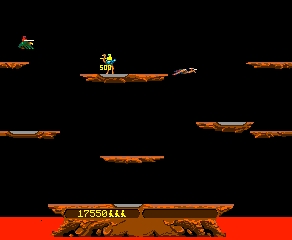
And lastly I remember Joust. This game first appeared in 1982.

You are a knight flying on an ostrich, battling buzzard-mounted enemies. You must defeat every enemy knight in a joust. You do not want to be knocked off into the boiling lava.

Joust is now available online. I haven't played it yet, so I can't tell you how the online version compares to the original arcade version.